Last week we wrote about exactly what happens to our pigs - from the day they're born to the day they die [1]. Most of our posts reach a few hundred people. That one has now been seen by more than 250,000!
We're just a small farm in Cornwall. It's amazing and we're very grateful. Thank you to everyone who read it, shared it or asked a question. Thank you especially to the people who stood up for us in the comments when we couldn't keep up. It genuinely means a lot to us.
We said we'd answer every genuine question. We've tried, but with over 1,200 comments it's taken some time. Apologies if we've missed a few. The same questions kept coming up, so here are the ones you asked most, with straight answers.
Where can I buy your pork? Do you post it?
This was the most asked by a long way. As one of you put it: "My only criticism is that you don't deliver to me!"
You can order at www.probusproduce.co.uk/shop or just send us a message. You can collect from the farm any day of the week if you let us know when you're coming. Delivery is free in Probus on any order. It's also free to Truro and St Austell on orders over £50. All our meat is supplied frozen. Christmas pork orders are open now too.
We don't post it, I'm sorry. We looked into shipping a while ago but couldn't find a courier we could rely on. We'll look again in the new year. If it works, we'll put a post up. So many of you asked that it's high on our priority list. (In case you're reading this in the future – it's written in Nov 2026).
How old are they when they're killed? Couldn't they live longer?
About 28–32 weeks, so seven to eight months. It takes a little longer in the colder months. The boys and girls go at the same age.
Some of you called that babies. It's young next to a pig's natural lifespan and I won't pretend otherwise. By then they weigh 80–90kg. Could we keep them longer? Every extra week means more feed. Feed is already our biggest cost by far, so the pork would have to cost a lot more.
How does that compare with most pigs?
One of you queried the figures in my last post, so I looked up the averages. AHDB puts the average UK pig carcase (in 2025) at about 91kg [2], which is around 120kg liveweight [3]. AHDB doesn't publish an age, but other sources put it at about five to six months. Ours are 80–90kg liveweight at seven to eight months. They're slower to grow to a lower weight. They spend those months outdoors too.
How exactly are they killed?
"Stunned electrically, not gassed" left a lot of you asking what that actually means. Fair enough. If we're going to say we're open about this, we should say it plainly.
Our pigs go with their brothers and sisters on a 30-minute trip to a small family-run abattoir. They're slaughtered within a few hours of arriving. I asked at the abattoir again on Monday 2 November when I dropped some pigs off. I was told they're stunned with an electric shock to the heart, which often kills them. They're all bled immediately after stunning. That means they're cut with a knife so the blood drains out, which makes sure they can't come round. I'm not an expert in the process or the biology, so I'm telling you what I was told. I don't yet know the full detail, including whether the current also goes through the head. I'll ask next time I'm there.
Several of you asked to see footage. We don't have any of the slaughter itself. We don't have permission from the abattoir to film there, but we will ask. What I can tell you is what I see when I drop ours off: they walk down the trailer ramp and go straight to sniffing around the yard. They look curious rather than frightened. I appreciate that may not be the case for most pigs and most abattoirs.
Don't you get attached? Aren't pigs just like dogs?
Sometimes it's hard not to. The piglets are cute, that's not really up for debate! But by the time they're 90kg, pushing you around and only interested in their feed, the fondness wears off. Our breeding animals are easier to get attached to. We have them for years and we give them names.
It helps that a pig isn't like a dog. They're clever, but nearly all of it is about food. They don't look at you the way a dog does. They don't look after one another. They will happily hurt one another (and anyone else) in order to get at food. Their social intelligence is nothing like a dog's.
So would they make good pets? Honestly, I wouldn't recommend keeping a farm animal as a pet.
None of that means they don't matter. Pigs feel hunger, comfort and fear. That's exactly why how they live and how they die matters so much to us.
You don't castrate. What about boar taint?
So far we've never had a problem with it. Nor have the other rare-breed pig keepers we've spoken to. Our boars are kept the same length of time as the gilts, about 28–32 weeks, so they aren't slaughtered any younger. The boys and girls live in separate groups.
We think there are a few reasons. Rare breeds seem to be less prone to it than commercial hybrids. Part of boar taint comes from skatole, which builds up more when pigs are kept crowded indoors. Ours live outside with plenty of space. Keeping the boys and girls apart also helps. That's what we think, not proven fact.
Why not keep them alive in a sanctuary?
It's a kind thought. But who would pay for the feed, the vet and everything else, for every pig, for fifteen-odd years each? Rare breeds have survived this long because people eat them. In 2024 there were just 288 breeding female Large Blacks in the whole of the UK [4].
If you believe killing animals is wrong, I know none of this will change how you feel about them not having a choice. I respect that.
Do many piglets get crushed by the sow? Do sows eat them?
I don't want to tempt fate, but so far we've had no piglets crushed and no sow has eaten her piglets. We're small scale, so we try to be there for every farrowing. The piglet creep with its heat lamp has worked wonders too. It gives the piglets a warm, safe spot away from mum.
How do I find farms like yours near me?
Sadly there isn't a list that tells you how farms keep their pigs, as far as I know. A couple of you pointed to online directories, so I had a look. They're paid listings with no apparent vetting of how the farms work, so being listed doesn't tell you how the pigs lived. I wish a proper one existed.
The best way is to ask your local butcher, farm shop or farmers' market where their meat comes from and whether it was raised outdoors. Or search for "rare-breed" and "free-range" pork near you. Be careful of terms like “outdoor bred” or “outdoor reared”. Both mean the pigs were born outside. Outdoor bred pigs only have to stay outside until they’re weaned. Outdoor reared pigs stay out for about half their lives. After that, most are moved into sheds to finish, so check the pack for how they were kept.
A few quick ones
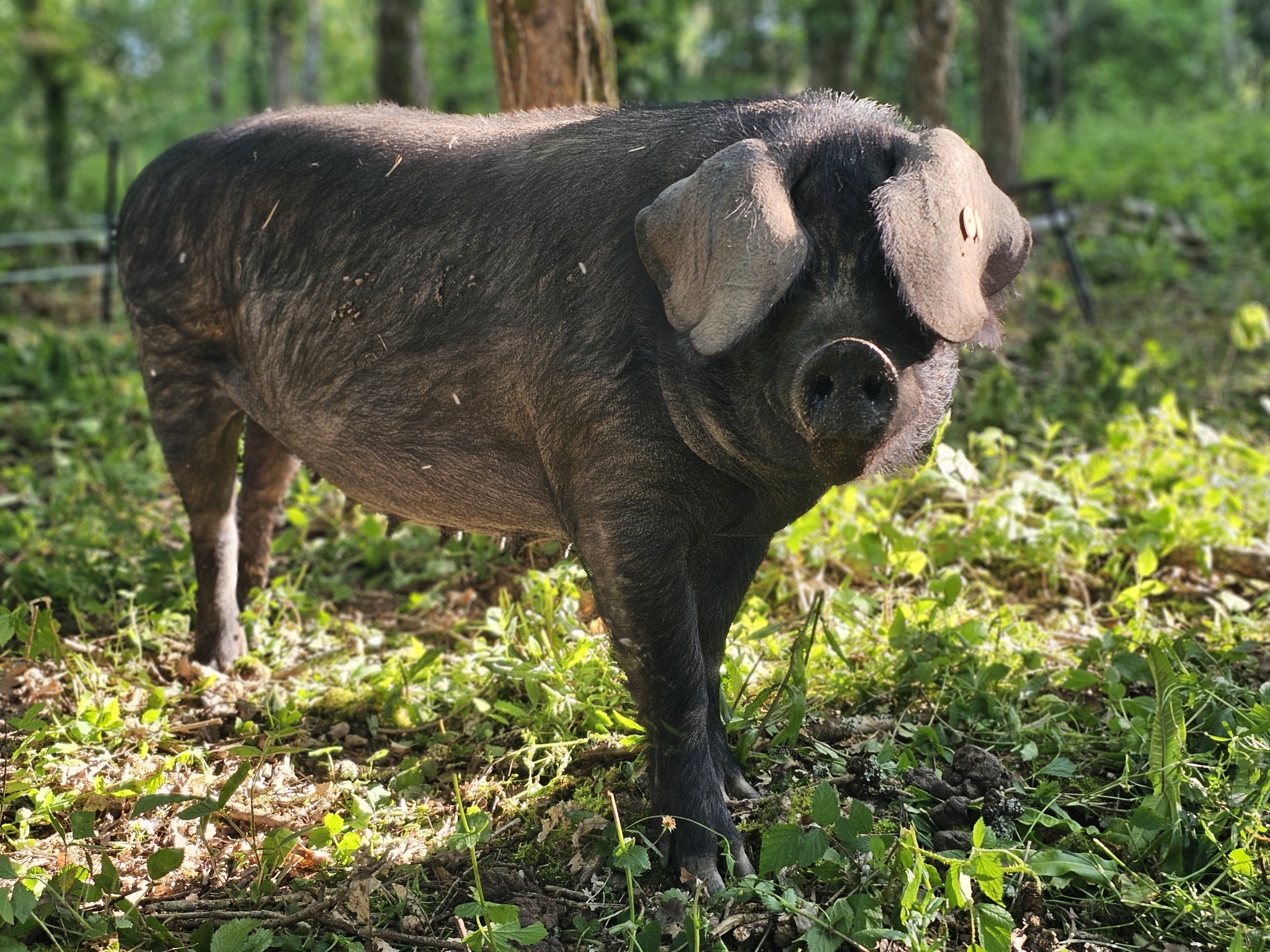
- Are they Berkshires? No, they're Large Blacks, although as a Cornish farm we call them Cornish Blacks. The breed has had lots of local names over the years. They're Britain's only all-black pig (Berkshires have a white sock on each leg).
- Are you organic? No. We looked at it but decided that on our scale the fees weren't worth it. For Soil Association organic status the fees would be c.£800pa.
- Is there soya in the feed? Yes, I'm afraid. We've looked into soy-free feed, but feed is already our biggest cost by far. In a more affluent part of the country we could probably put our prices up to pay for it. Down here in Cornwall it's sadly just not possible.
- Is your bacon nitrite-free? Not at the moment. We've made our own without it before, but we're not set up to sell it yet. We hope to offer it next year.
What can the rest of us do about factory farming?
I think pig farming is vastly misunderstood. Companies should be honest and open about how their animals are kept, without the marketing spin. It doesn't help that there's so much one-sided information out there (from both sides). What people need are facts, so they can make up their own minds.
So keep asking; ask your butcher, your farm shop and your supermarket how the pig lived. What the words on a pork pack actually mean is a big enough subject for its own post ('outdoor bred/reared/raised', 'free-range', 'organic' etc).
What you said
Some of your comments have really stayed with us. A lot of them came from people who don't eat meat:
"I have been vegetarian for nearly 40 years. I might not have made that decision if there had been more farms like yours and transparency so that I was aware of them."
"I'm vegan but totally respect the way you take care of your animals"
"I do not eat meat simply because of how we raise, feed and slaughter. BUT IF I DECIDED TO I WOULD BUY YOUR MEAT!"
Others came from people who've kept pigs themselves:
"I was a pig farmer in France for many years. This means I'm qualified and I cannot assure you readers enough that if you eat pork, this is the only pork you should eat."
"We used to breed rare breed pigs and sell the pork. If these rare breeds were not being bred in this manner they would become extinct. If you eat meat this is absolutely the best way to eat it."
"I raised Large Blacks for meat on our smallholding and knowing them and caring for them has been one of the greatest privileges of my life."
Some of you made us laugh too:
"What a sensible clear explanation- ever thought of taking up politics?"
I'll stick to pigs, with them the manure only comes out of one end! 😂
Thank you. Reading those meant a great deal to us.
It hasn't all been kind
It wouldn't be honest to leave out the rest. In the last post I asked people to disagree without hurling insults. Some of those who disagree couldn't resist. Two examples:
"You are murdering psychopaths. You don't have to kill animals, you purposely choose to. That means you enjoy the murder part. You are disgusting. Vile."
"If their lives are so great, why don't you allow yourself the same and send yourself on the short journey to the local abbatoir?"
We've left nearly all of it up, because people's comments say more about them than about us. We've only hidden a handful of the very worst - whoever they came from - as some of the abuse aimed at vegans was no better. Those comments don't speak for everyone who disagrees with us. Plenty of you disagree completely and were polite about it.
If we've missed your question, ask it. Thank you again, all of you.
— Jon
Sources
- [1] Our last post: www.probusproduce.co.uk/farm-journal/what-really-happens-to-our-pigs
- [2] Average UK pig carcase weight in 2025: AHDB data reported by 3tres3, www.3tres3.com/en/latest_swine_news/uk-pig-industry-saw-strong-year-in-2025_22170 and AHDB's pork market update, ahdb.org.uk/news/another-strong-year-for-uk-production-pork-market-update
- [3] How much of a pig's live weight ends up as carcase: AHDB, ahdb.org.uk/knowledge-library/killing-out-percentage
- [4] The Large Black's rare breed status: Rare Breeds Survival Trust, www.rbst.org.uk/watchlist-breed/large-black