Last week's post about small farms went further than anything we've ever put out: more than 1,000 reactions and over 300 comments. Thank you to everyone who read it and shared it. Thank you especially to the people who stood up for us in the comments.
A lot of you asked how our pigs are kept and how they're killed. Some of you don't think animals should be farmed at all. We respect your decision. If you believe killing animals is wrong, nothing I write here will change your mind. I'm not trying to. This is for people who do eat meat and are deciding where to buy it. The reason I want to write this is that a lot of what was said about pig farming isn't true of us. I'd rather you knew exactly what we do than lumped us in with something we're not.
One more thing first. Some of the comments turned to religion and immigration. This isn't about anyone's religion or political opinions and those comments don't speak for us.
Where I'm coming from
I should be honest: I'm biased. I grew up here, around livestock. Farming is how we make our living. That shapes how I see things.
But everyone's view is shaped by something: how they were brought up, what they've seen, who they talk to, what turns up in their social media feed(!). That goes for meat eaters and non-meat eaters. Me included.
Everyone's entitled to their opinion. I'd never want to stop anyone saying what they think, on our page or anywhere else. All I'd ask is that it's based on facts and first-hand experience rather than whatever gets shouted the loudest. A lot of the footage people mentioned comes from huge indoor units and abattoirs that are nothing like ours. So here's what actually happens to our pigs.
Born
"Outdoor bred", "outdoor reared" and "outdoor raised" all sound much the same, but they mean different things. Some of those phrases still mean that pigs spend a good part of their lives indoors.
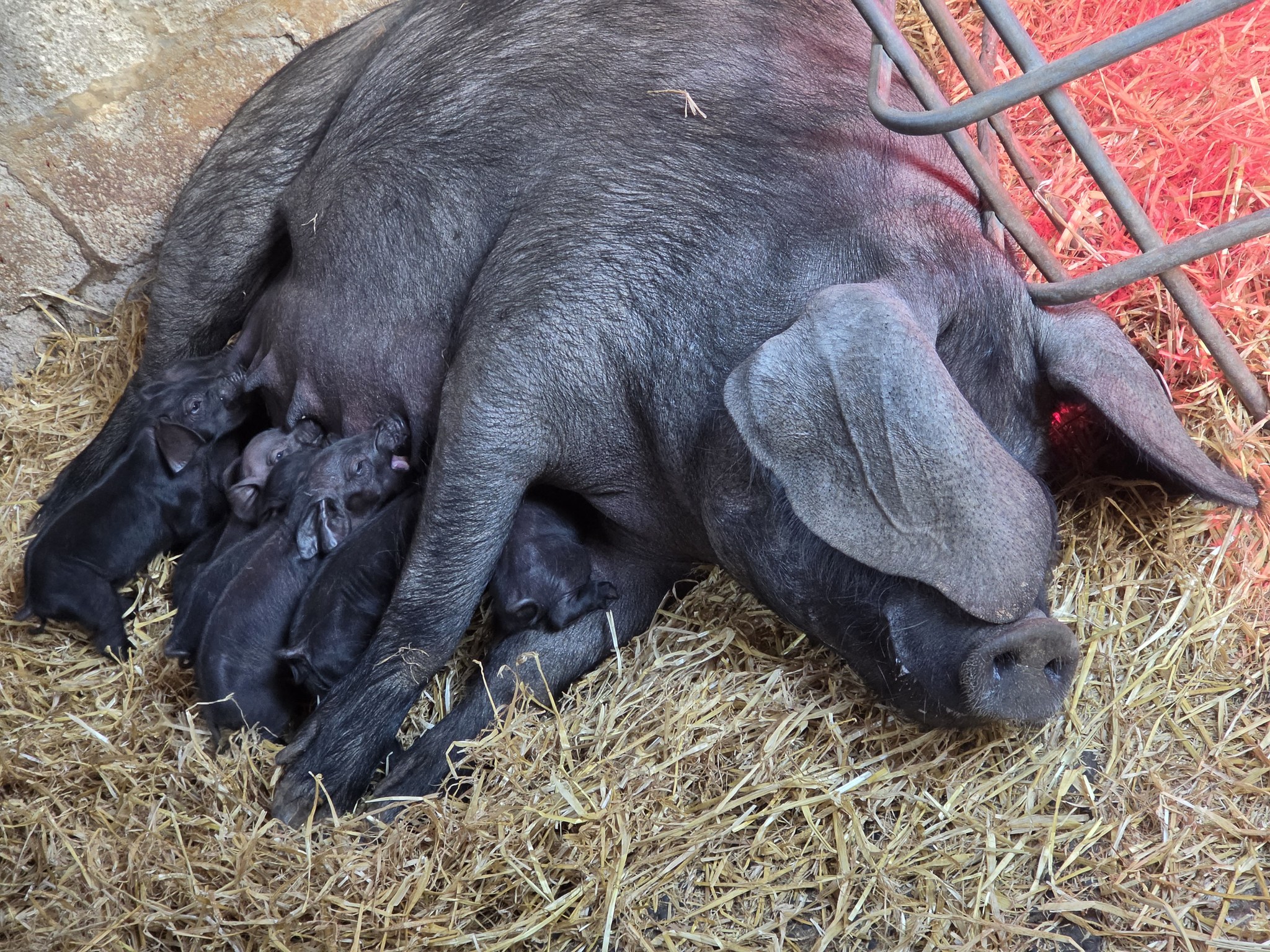
Ours are born inside, in a barn. When a sow is close to farrowing, she moves into a pen in the barn where we can keep an eye on her and the piglets. She isn't in a farrowing crate. She has the run of the pen and can go outside whenever she likes. The only "crate" in there is a piglet creep: a corner with a heat lamp where the piglets can get warm and out of mum's way, so she doesn't lie on them.
The only time we shut them in is for their own safety.
Weaning
We leave the piglets with their mum for as long as we can, because it's good for them. We wean them when she's had enough of them or when feeding them is pulling too much condition off her. That's usually somewhere between five and eight weeks. The legal minimum is four weeks and many farms wean then [4].
Sometimes a sow gets properly fed up and starts turning on her litter. If that happens we move the piglets to protect them and her.
What we don't do
No farrowing crates. No tail docking. No teeth clipping. No castration. No nose rings.
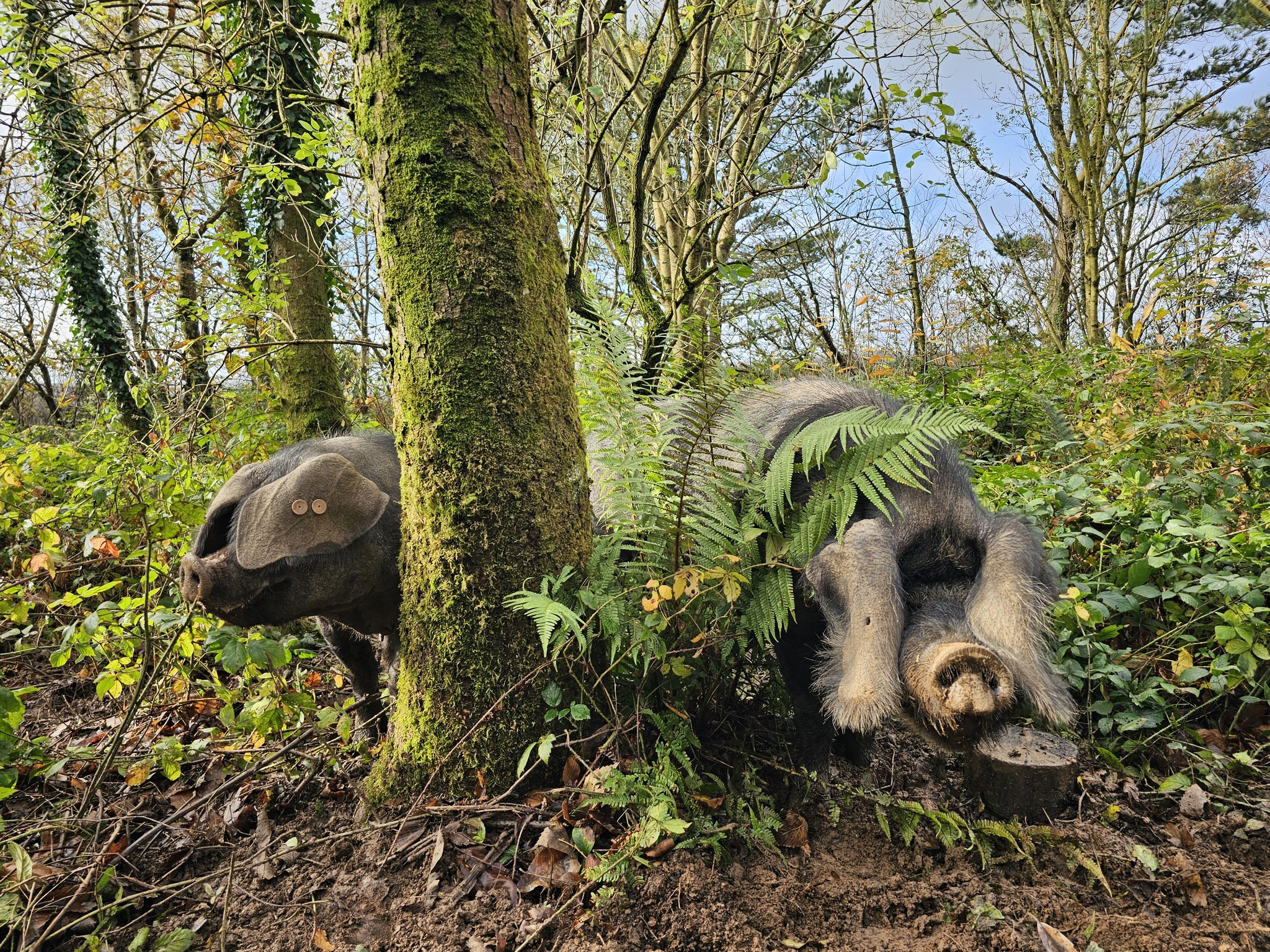
On many indoor farms, tails are docked and teeth clipped to stop pigs injuring each other when they're crowded and bored. Routine tail docking isn't allowed in the UK [4], but the pig industry's own survey found about 70% of pigs had docked tails [5]. Our pigs live outside, they have space, woodland and ground to dig in, so they don't need it. Nose rings stop pigs rooting. Rooting is the thing a pig loves most. Ours root all day.
Growing
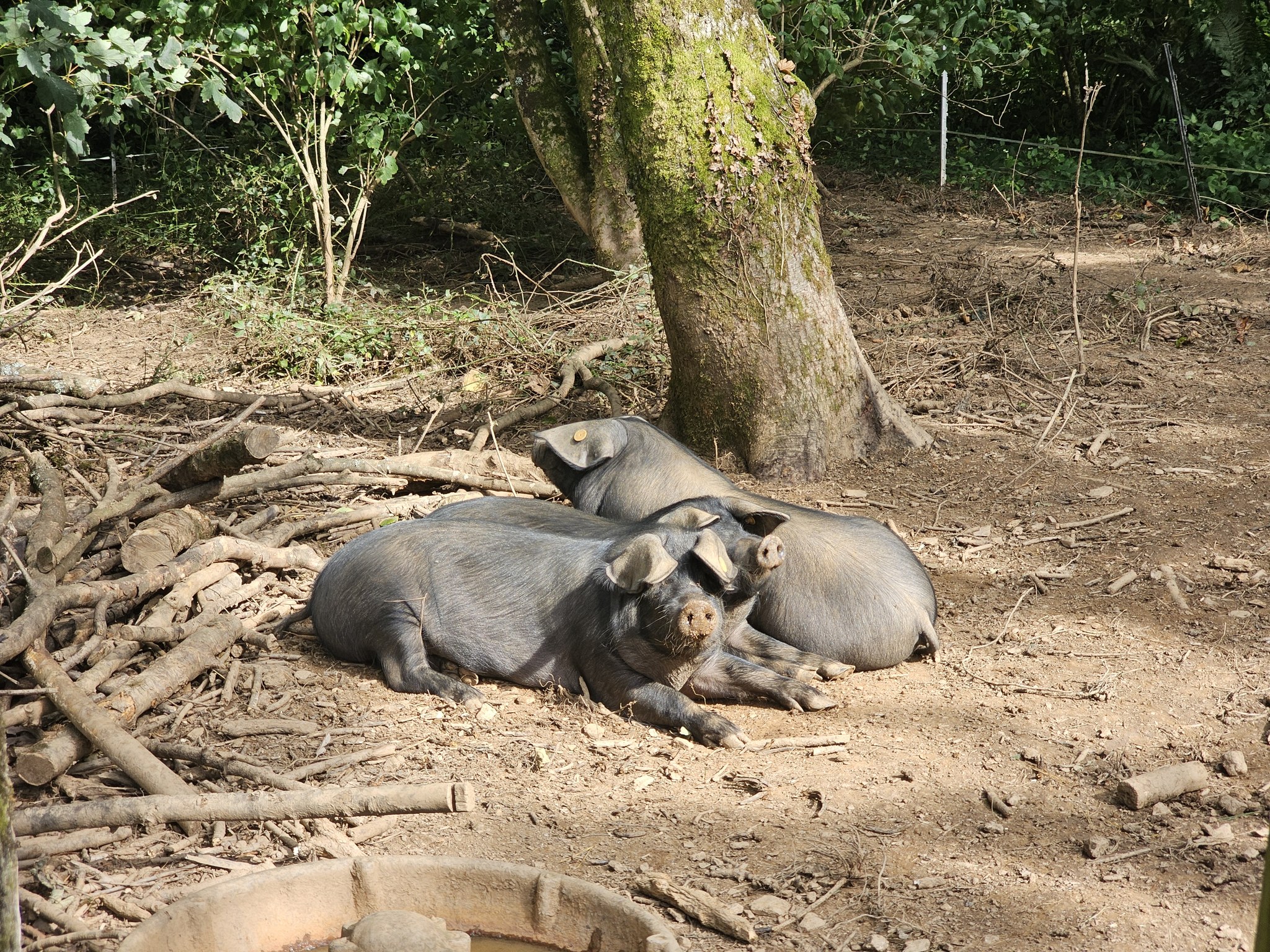
After weaning, our pigs live out in the woodland. They grow slowly, reaching 80–90kg at seven to eight months. Most UK pigs, around 96% after weaning [6], are kept indoors. Most are fast-growing hybrids that reach about 120kg at four to five months.
When they reach the right age and weight, we sell the pork. That's how we pay for the feed, the vet, the bedding, the fencing, the arks, the ear tags, the land, the water and the BPA herd register. If money were all we cared about, we'd keep fast-growing hybrids indoors like most farms do.
Someone in the comments said we kill babies. Seven or eight months is young next to a pig's natural lifespan, I won't pretend otherwise. But it's nearly twice as long as most pork pigs get. And - importantly, nearly every day of it is spent outdoors.
Are pigs cleverer than dogs?
We've got dogs and pigs. In my experience the dogs are vastly more intelligent. I've yet to meet a pig that'll fetch a stick.
Pigs aren't stupid. Their intelligence is just different. Nearly all of it is about food. There's a well-known study where a pig that knew where food was hidden learned to keep a bigger pig, one that would steal it, from following it there [2]. That's clever. It's also entirely about getting food. Watch our pigs for a day and nearly everything they work out has food at the end of it.
What they don't do is look out for each other. One of ours went off his feed and needed antibiotics. His brothers didn't rally round him: they ignored him and pushed him out of the way at feeding time. When we tried to put one of our sows back in with two of her own gilts, she fought them for food, even though there was plenty for all three. A lot of what gets shared online gives pigs human feelings and loyalties. That isn't what I see, day in, day out.
The "smarter than dogs" line mostly comes from a 2015 review paid for by an animal-rights campaign [3].
But honestly, whether a pig is cleverer than a dog isn't the point. Pigs feel hunger, cold, comfort and contentment and, importantly, they can feel fear. That's exactly why how they live and how they die matters so much to us.
The last day
When it's time the pigs go (with their brothers and sisters), on a 30-minute trip to a small family-run abattoir near us. We tried the bigger abattoirs in the area. They're busy, with lorries unloading cattle and sheep all day. Ours is calm and each group has its own small pen.
I'm not going to pretend our pigs skip off the trailer. But they walk off on their own and they go straight to exploring the new pen and all its smells. They don't look frightened. They look curious. That's what I've seen with my own eyes, many times. This is genuinely true and not something I'm just saying to make people feel better about eating meat.
They're slaughtered within a few hours of arriving. They're stunned electrically, not with gas. Every English abattoir has had to have CCTV wherever there are live animals since 2018. The Food Standards Agency's vets can check the footage.
I can't speak for the big abattoirs or for gassing. It's not something we use or support.
That's why the abattoir closures I wrote about last week matter so much. Some comments called them good news. But fewer small abattoirs doesn't mean fewer animals going to slaughter. It means longer journeys to bigger, busier places, which is exactly what we've tried to avoid. In 2021, 87 abattoirs in England killed pigs. Just 11 of them handled 92% of all the pigs slaughtered [7].
The five freedoms
One commenter asked us to set out our welfare against the "five freedoms", the standard animal welfare benchmark in the UK [8]. It's a fair question, so here goes.
- Freedom from hunger and thirst. Our pigs are fed twice a day, every day. They always have fresh water and forage in the woodland on top. - Freedom from discomfort. They have arks with straw bedding to sleep in, trees for shade and shelter, plus mud to wallow in. - Freedom from pain, injury and disease. We check them at least twice every day and get the vet when they need one. No tail docking, teeth clipping, castration or nose rings. - Freedom to express normal behaviour. Rooting, wallowing, foraging, living in a group with their brothers and sisters, plus five to eight weeks before weaning. That's most of what a pig wants out of life. Ours get all of it, in a natural environment. This isn't "rooting in deep straw bedding", which is what it means on a lot of pig farms. - Freedom from fear and distress. Calm handling, no farrowing crates, a short trip with their siblings at the end, then a quiet abattoir where they're stunned electrically, not gassed.
Better never to have lived?
If nobody eats rare breeds like ours, nobody breeds them and they disappear. That's not a threat, it's just how it works.
The Rare Breeds Survival Trust puts the Large Black (our Cornish Black) in its Priority category, the most at risk. In 2024 there were just 288 breeding females in the whole of the UK. All 11 of Britain's native pig breeds are on its watchlist [11]. The story goes that the breed began in the 1700s, when boatloads of black pigs from China landed in Cornwall. It would be a shame to lose it, here of all places.
A few people suggested we keep the breed going but stop eating them. It's a kind thought. But who would pay for the feed, the vet and all the other costs, for every pig, for fifteen-odd years each, with nothing to sell at the end? Rare breeds have survived this long because people eat them.
So for our pigs the choice isn't between being eaten and living a long life in a field somewhere. It's between a good life outdoors, rooting, wallowing, sleeping in a heap with their siblings, then one day a short trip to a new pen and lights out. Or no life at all. I know which I think is better.
About some of the comments
Most of the comments on last week's post were kind, curious or thoughtful. Some weren't. We were called murderers, barbarians, sadistic monsters, torturers and abusers. One comment compared what we do to Nazi Germany. Others cheered that abattoirs are closing and small farms are going out of business.
That isn't OK, whatever you think about eating meat. Around 86% of adults in the UK eat meat. About 2% are vegan [10]. People in Britain have kept and eaten pigs for thousands of years. Habits are changing and that's fine. But calling most of the country murderers won't change anyone's mind. And cheering when small British farms and businesses go under seems short-sighted, even vindictive. People won't stop eating pork when we've gone. More of it will just come from bigger, more intensive farms, much of it from abroad.
I don't understand the mentality of throwing abuse at someone to try to change their mind. It baffles me. If you disagree with us (and you're absolutely entitled to), please do it without hurling insults.
If you eat meat
We think meat has a place. If you eat it, eat meat that has had a good life, was slaughtered humanely and is sold close to where it was raised. If cost is an issue, eat a bit less of it, but better. Ask your butcher or farm shop where it came from and how it lived. Consider buying registered rare-breed meat: it's not only helping to stop them going extinct, it will be higher quality and have better taste.
And don't waste it! A pig is a fantastic example of nose-to-tail butchery. Pigs aren't skinned like cattle and sheep: the skin stays on and becomes crackling and bacon rind. About three quarters of a pig's live weight ends up as carcase, compared with 50–60% for cattle and under half for a lamb [9].
We use as much of each one as we possibly can: joints, chops, bacon, gammon, sausages, mince and now our first coppa. We have the heads and trotters back and sell them. Over the years we've also had the heart, liver, kidneys and even the lungs back too. If you want anything specific, we can add it to our cutting list for you!
A lot of you asked whether we deliver nationwide. At the time of writing (Nov 26) - we don't, sorry: we're too small. But you can still buy this kind of pork near you. Ask your local butcher or farm shop for free-range rare breed pork, or look up a pedigree breeder near you on the British Pig Association's website [12].
Lots of you told us you've kept rare breeds yourselves: Lops, Tamworths, Saddlebacks, Berkshires, Large Blacks. We loved reading those. Thank you.
If you have any other questions about how we farm, ask. We'll always give you a straight answer.
— Jon
Sources
- [1] Our last post, on why small farms matter: probusproduce.co.uk/farm-journal/small-farms
- [2] Pigs and food (the "informed forager" study): Held, Mendl, Devereux & Byrne, "Social tactics of pigs in a competitive foraging task", Animal Behaviour 59 (2000), 569–576. Read the study
- [3] "Smarter than dogs": Marino & Colvin, "Thinking Pigs: A Comparative Review of Cognition, Emotion, and Personality in Sus domesticus", International Journal of Comparative Psychology 28 (2015). Read the review. Who paid for it: Farm Sanctuary's own press release
- [4] The rules on tail docking and weaning age: the government's Code of practice for the welfare of pigs
- [5] How many pigs have docked tails: AHDB Real Welfare report, via Farmers Weekly
- [6] How many UK pigs are kept indoors: Advertising Standards Authority ruling on Viva! (2018), citing RSPCA and Compassion in World Farming figures
- [7] How few abattoirs handle most pigs: AHDB figures for England, 2021, via FarmingUK
- [8] An animal's welfare needs in law: Animal Welfare Act 2006, section 9
- [9] How much of each animal ends up as carcase (killing-out percentage): AHDB, pigs; AHDB, lambs; Farm Advisory Service, cattle
- [10] How many people in the UK eat meat: YouGov's diet tracker (January 2026), via Our World in Data
- [11] The Large Black's rare breed status and history: Rare Breeds Survival Trust
- [12] Find a pedigree pig breeder near you: British Pig Association